.png?width=200&height=58&name=RheoSense%20Logo%20(REGISTERED).png)

.png?width=300&name=Banner%20Image%20Polyethylene%20Terephthalate%20(PET).png)
Determining Inherent Viscosity of Polyethylene Terephthalate (PET)
Inherent Viscosity of PET as in ASTM D4603-18
Key words: Polyethylene Terephthalate (PET), Inherent Viscosity, ASTM D4603-18, microVISC PRO, Continual Sample Testing, Microfluidic Viscometry, Polymer Analysis
Introduction
Determining the inherent viscosity of polyethylene terephthalate (PET) is a critical quality control and research metric, typically guided by standard test methods such as ASTM D4603-18 (ASTM International, 2018).
While capillary and rolling ball viscometers are common for inherent and intrinsic viscosity measurements, they present several pain points. These gravity-driven methods typically require time-consuming wash cycles and significant solvent usage. Open or semi-open systems also pose a risk of solvent evaporation during lengthy test sequences, which can alter solution concentration and skew intrinsic viscosity results. Moreover, manual capillary viscometers suffer from very low throughput (labor-intensive and slow temperature equilibration) and are highly susceptible to operator variability, which compromises data repeatability.
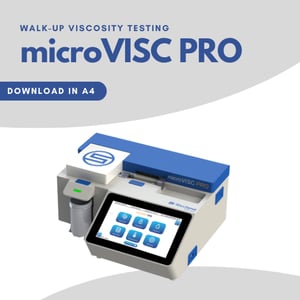
The RheoSense microVISC PRO, a walk-up friendly viscometer, directly addresses the pain points of traditional methods for inherent and intrinsic viscosity measurements. The continual sample testing capability eliminates the need to clean between compatible samples, while the built-in Peltier temperature control of the microfluidic system allows for fast and stable temperature equilibration, helping to improve throughput. Cleaning at the end of the sequence typically involves loading one pipette with cleaning solvent, starting the cleaning job on the unit, and walking away. In addition, the microfluidic, closed-system design of the microVISC PRO prevents solvent evaporation, allows for small sample requirement (~ 100 µL), and ensures the high accuracy and repeatability essential for intrinsic viscosity analysis.
This application note demonstrates how the microVISC PRO, with these advantages, is leveraged to efficiently and accurately determine the inherent viscosity of PET samples, in alignment with ASTM D4603-18.
Sample Preparation
Solvent mixture and PET solution preparation was performed based on ASTM D4603 – 18.
-
· Solvent mixture: Consists of 0.2 wt.% n-octyl-bis-(isoethyl mercaptoacetate) added to 60/40 wt.% phenol/1,1,2,2-tetrachloroethane (density ≈ 1.234 g/mL).
o Prepared by mixing the solvents in a closed 20 mL glass vial at room temperature until all phenol was dissolved.
-
· PET solution: Consists of 0.518 g/dL PET in solvent mixture.
o Prepared by mixing in a closed 20 mL glass vial on a hotplate stirrer at 110 °C for 15 minutes. The vial was then removed from the hotplate, inspected for fully dissolved PET, and allowed to cool to room temperature.
Measurement & Data Analysis Approach
Shear viscosity measurements were performed at 30 °C using the RheoSense microVISC PRO viscometer equipped with an A05 chip (depth = 50 µm, Pmax = 12 kPa). A sample volume of approximately 350 – 400 µL was loaded for each pipette. 3 – 4 pipettes were measured for each sample (solvent mixture, PET solution), with each pipette giving at least 10 separate viscosity readings. Initial profiling confirmed both the solvent mixture and PET solution displayed Newtonian behavior; hence, samples were measured at separate shear rates to ensure high signal-to-noise ratio.
Continual testing was possible since no cleaning was required between the samples. After the tests were completed, the chip was cleaned with one pipette of the solvent mixture, followed by one pipette of IPA.
All data was reprocessed and filtered with the Clariti data analysis software.
The inherent viscosity, ηinh, is given by: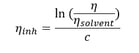
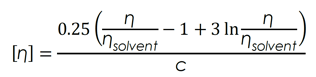
The parameters are the following:
-
η = measured PET solution viscosity
-
ηsolvent = measured solvent mixture viscosity
-
c = PET concentration
The intrinsic viscosity, [η], is calculated based on the Billmeyer relationship:
Results & Conclusion
The measured viscosity at 30 °C of the PET solution and solvent mixture is 5.70 and 4.29 cP, respectively (see Table 1 below). The corresponding %RSD of viscosity is < 0.5%. The calculated inherent viscosity is 0.546 dL/g, while the intrinsic viscosity (based on Billmeyer equation) is 0.567 dL/g. These results demonstrate the efficacy of the microVISC PRO to measure the viscosity of polyethylene terephthalate (PET) and organic solvent mixture solutions with ultra-high repeatability, with no cleaning needed between samples measured.
Table 1. Viscosity, %RSD, inherent viscosity, and intrinsic viscosity of the PET solution and solvent mixture.
| T = 30 °C | Viscosity, cP | %RSD of Viscosity | Inherent Viscosity, dL/g |
Intrinsic Viscosity (Billmeyer), dL/g |
| PET Solution (c = 0.518 g/dL) |
5.70 | 0.325 | 0.546 | 0.567 |
| Solvent Mixture | 4.29 | 0.239 | N/A | N/A |
Reference(s)
ASTM International. (2018). Standard test method for determining inherent viscosity of poly(ethyleneterephthalate) (PET) by glass capillary viscometer (ASTM D4603-18). https://doi.org/10.1520/D4603-18
If this note is helpful, please let us know! If you have questions or need more information about this product or other applications, please contact us:
Main Office — 1 925 866 3801
Sales – Sales@RheoSense.com
Information — info@RheoSense.com


%20%20to%20equilibrate%20temperature%20CTA.png?width=287&height=287&name=Allow%20medical%20grade%20viscosity%20standard%20(MGVS)%20%20to%20equilibrate%20temperature%20CTA.png)