

<img height="1" width="1" style="display:none;" alt="" src="https://dc.ads.linkedin.com/collect/?pid=510762&amp;fmt=gif">
Skip to content
Extensional Collage Banner

What is Extensional Viscosity?

EXTENSIONAL VISCOSITY IS:

Viscosity Measured During an Extensional Flow Event

Extensional viscosity is a type of viscosity measured using extensional stress to deform the fluid. Extensional stress is caused by stretching as oppposed to shearing.

Extenstional viscosity is an important paramenter in the characterization of non-Newtonian fluids. Measuring extensional viscosity gives insight into the behavior of a fluid when presented with a constricting force.

For example, how will a salad dressing behave differently in a standard bottle vs a squeeze bottle? Some might split or clog a spout.

How do we measure extensional viscosity?

Extensional viscosity requires specialized instrumentation to measure. Many academic researches build custom rheometers for their projects. The RheoSense m-VROC II is the only extensional viscometer available commercially.

Viscometers typically measure a fluid's resistance to flow by using shear stress and cannot measure extensional viscosity.

What is the difference?

Extensional Stress

A fluid is propelled through a channel with significant restriction. During this restriction, the fluid exhibits different resistance and can be quantified using an extensional viscosity measurement.

Extensional Viscosity Icon August 2026
What is the difference?

Shear Stress

Shear stress is created when pressure is applied in a parallel manner like a box being pressed down on a table. 

In VROC viscometers, this happens when fluid is pushed through a static microfluidic channel.

New Shear Icon August 2026
Applied Extensional Viscosity

Examples of Extensional Viscosity

Pesticides Spraying
Agricultural Sprays

As pesticide formulations are forced to constrict in the spray nozzle, chemical bonds re-arrange causing a change in viscosity that allows a spray to develop. 

Foamy Hot Chocolate Whisked on Stove
Learn More
Food Additives and EmulsifiersMany food products experience extensional flow events. For example, products dispensed from bottles rely on extensional viscosity for pourability, stringiness, and mouthfeel. Even cheese pull and dipping consistency are impacted by extensional viscosity.
Learn More
Oil Recovery
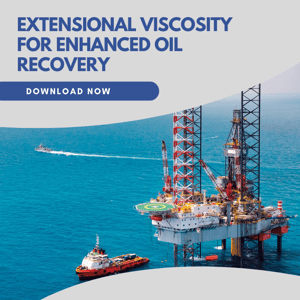
Enhanced Oil Recovery

Advanced oil recovery methods (EOR) push oil left in an environment through aerated sediment or porous rock to be extracted at a better location. This process changes the viscosity of non-Newtonian fluids, so the liquids used in the process must be tested for extensional viscosity.

Ink Cartridges in Inkjet Printer
Printing & Writing

During jetting, ink enters a converging orifice; extensional viscosity governs filament breakup and misting.

Writing with a ballpoint pen is also an example of extensional viscosity changes.

Rolling Blue Paint onto Paneled Raw Wood
Paint Application

Paint is subjected to extensional viscosity in almost every application method at the brush/roller contact zone. It’s testing is important because poor responses to extensional viscosity can cause dripping or other issues with adhesion.

Google+