

What is Extensional Viscosity?
A fluid’s resistance to being stretched, rather than sheared
Extensional vs. Shear Viscosity
| Shear viscosity | Extensional viscosity | |
|---|---|---|
| Type of flow | Layers slide past each other | Fluid is stretched or squeezed through a narrowing |
| Everyday example | Stirring, pouring, pumping through a pipe | Spraying, inkjet printing, dispensing through a nozzle |
| What it predicts | Flow rate, pumping force, spreading | Droplet formation, stringiness, misting, filament breakup |
| Measured with | Most viscometers and rheometers | Specialized extensional instruments |
Why Extensional Viscosity Matters
How Is Extensional Viscosity Measured?
Extensional Stress
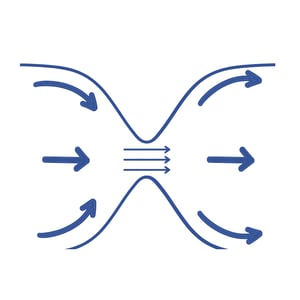
Fluid is stretched as it accelerates through a narrowing channel. Its resistance to that stretching is its extensional viscosity.
Shear Stress
Shear stress is created when force is applied parallel to a surface, like a book sliding across a table.
In VROC powered viscometers, this happens when fluid is pushed through a static microfluidic channel.

Examples of Extensional Viscosity

As a pesticide formulation is forced through a narrow spray nozzle, it stretches. How much it resists that stretching, which is its extensional viscosity, controls how the spray breaks into droplets. That affects droplet size, coverage, and how much spray drifts off target.

Enhanced oil recovery (EOR) injects polymer solutions into a reservoir to push leftover oil through porous rock toward production wells. As the solution squeezes through the tiny pores, it is stretched again and again. Its extensional viscosity affects how well it pushes oil out, so testing it helps operators choose the most effective formulation.
Read More

In inkjet printing, ink is forced through a tiny nozzle and stretches into a thin stream before it breaks into droplets. Extensional viscosity decides whether those droplets form cleanly or leave behind stray drops and mist. The same stretching happens when you write with a ballpoint pen, and it affects how smoothly and evenly the ink reaches the page.

Whether it’s applied by brush, roller, or spray, paint is stretched as it’s applied. As a roller lifts off a wall, for example, paint is pulled into thin strands that eventually snap. Extensional viscosity controls how those strands break. It determines whether the result is a smooth, even finish or spatter, mist, and streaks. Testing it helps formulators create paints that go on clean every time.
Extensional Viscosity FAQ
Common questions about extensional viscosity, how it differs from shear viscosity, and how it’s measured.
Shear viscosity measures a fluid’s resistance when its layers slide past each other, as in stirring or pumping. Extensional viscosity measures its resistance to being stretched, as in spraying, printing, or squeezing through a nozzle. Complex fluids can have similar shear viscosity but very different extensional viscosity.
Yes. Elongational viscosity and extensional viscosity are two names for the same property: a fluid’s resistance to stretching flow.
The Trouton ratio is extensional viscosity divided by shear viscosity. For simple Newtonian fluids under uniaxial stretching, it equals 3. For polymer solutions and other complex fluids, it can be much higher, which shows the fluid resists stretching far more than its shear viscosity suggests.
In complex fluids, stretching uncoils and aligns long molecules such as polymers and proteins. This raises resistance to stretching in a way that shear flow does not trigger. Two fluids with the same shear viscosity can behave very differently in a nozzle or spray.
Extensional viscosity requires specialized instruments, because standard viscometers measure only shear. Methods include filament stretching, capillary breakup, and contraction flow. The RheoSense m-VROC II uses a microfluidic hyperbolic contraction to measure both extensional and shear viscosity on one instrument.
Strain hardening is when a fluid’s extensional viscosity rises as it is stretched further or faster. It happens in polymer solutions and other complex fluids as long molecules uncoil and align. Strain hardening keeps threads and filaments from breaking, which affects spray droplet size, stringiness, and how well polymer solutions push oil through rock in enhanced oil recovery.
Related Resources & Further Reading
Further reading
- Petrie, C. J. S. (2006). Extensional viscosity: A critical discussion. Journal of Non-Newtonian Fluid Mechanics, 137, 15–23.
- McKinley, G. H., & Sridhar, T. (2002). Filament-stretching rheometry of complex fluids. Annual Review of Fluid Mechanics, 34, 375–415.
- RheoSense webinar: Extensional Viscosity: Theory and Practice
- RheoSense webinar: Extensional Viscosity: Practical Applications