
<img height="1" width="1" style="display:none;" alt="" src="https://dc.ads.linkedin.com/collect/?pid=510762&amp;fmt=gif">
Skip to content
Extensional Banner

Extensional Viscosity Measurements

with m-VROC II and VROC initium 1++

Now measure extensional viscosity, on the m-VROC II and VROC initium 1++. Same trusted VROC technology, same easy workflow.


Droplet icon representing small sample volumes
Small Samples
Small sample volumes 
VROC initium 1++ viscometer line art
VROC initium 1++
Automate your extensional and shear viscosity measurements
m-VROC II viscometer line art
Extensional Viscosity

Enhance your R&D capabilities

Icon representing Newtonian and non-Newtonian fluid testing
Non-Newtonian Samples
Test Newtonian and non-Newtonian fluids

Extensional Viscosity on the m-VROC II and VROC initium 1++

Extensional viscosity is a fluid's resistance to being stretched. RheoSense measures it on the m-VROC II and the VROC initium 1++ using extensional chips and small sample volumes, with the same easy workflow you use for shear viscosity.

Many real-world processes stretch fluids: a protein formulation squeezing through a needle, an ink jetting from a nozzle, a coating spraying onto a surface. Shear viscosity alone can miss how these fluids respond, and extensional viscosity can tell apart formulations that look identical in shear.

There are multiple extensional chip options to match your application. View the chip selection guide [DRAFT: replace this link with the extensional chip spec sheet]
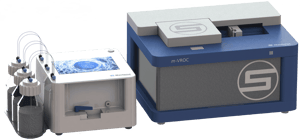
m-VROC II small sample viscometer with chip cleaning station
Extensional Technology

HOW EXTENSIONAL VISCOSITY IS MEASURED

Understanding Fluid Behavior — Measuring Resistance to Extensional Flow

Extensional chips contain a microfluidic contraction. As the sample flows through the contraction, the system measures the pressure upstream and downstream of it with MEMS pressure sensors and calculates the apparent extensional viscosity at a defined extension rate. The m-VROC II software (version 1.3.0.0) supports extensional viscosity measurements. Built on VROC® Technology with MEMS-fabricated chips, the platform needs only a small sample.

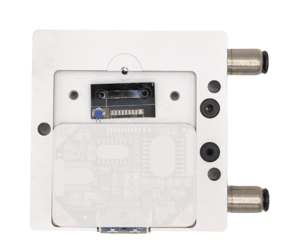
VROC microfluidic chip mounted on its sensor board
Health care researchers working in lab
"[DRAFT: add a customer quote about extensional viscosity measurements here.]"
NAME [PLACEHOLDER]COMPANY [PLACEHOLDER]
SPECIFICATIONS

Extensional viscosity (m-VROC II and VROC initium 1++)

  • Measured quantity: apparent extensional viscosity, from pressure measured upstream and downstream of a microfluidic contraction
  • Extensional chips: EA20, EB20 [CONFIRM full list and naming vs. A20, B20, C20, E20 on the spec sheet]
  • Extension rate: set by flow rate; the software converts between flow rate (µL/min) and extension rate (1/s). Range per chip: [X ~ Y] 1/s
  • Syringes: 100 µL and 2.5 mL
  • Sample volume for an extension rate sweep: at least 80 µL (100 µL syringe) or 1.3 mL (2.5 mL syringe)
  • Maximum flow rate: 1,200 µL/min (Regular pump, 100 µL syringe)
  • Extensional viscosity range: [X ~ Y] mPa-s (cP)
  • Accuracy: [X]% of reading
  • Repeatability: [X]% of reading
  • Software: m-VROC II software version 1.3.0.0 supports extensional measurements
  • Sample retrieval and chip cleaning with the RheoSense Chip Cleaning Station (CCS)
  • Fluids: Newtonian and non-Newtonian solutions

Extensional Viscosity FAQ

Quick answers about measuring extensional viscosity with the m-VROC II and VROC initium 1++.

What is extensional viscosity?

Extensional viscosity is the resistance of a fluid to extensional flow, meaning flow where the fluid is stretched. Any flow involving a change in cross-sectional area is affected by it. It matters in processes such as fiber spinning, roll coating, inkjet printing, spraying and electrospinning.

Google+