|
Type of Viscometer
|
Minimum Sample Volume
|
Estimated Viscosity range
|
Can it Test Non-Newtonian Samples?
|
How Much Time Does it Take to Test?
|
How Time-Consuming is it to Clean?
|
User Variability
|
Temperature Control
|
|
Capillary
(U-tube)
Ostwald, Ubbelohde, Cannon-Fenske
|
~2–10 mL
Moderate sample sizes.
|
~0.3–100,000 cSt. Viscosity only given in cSt, not in cP.
|
Capillary viscometers can test Newtonian samples only.
|
20–40 min total: 10–20 min thermal equilibration + 3–15 min flow time; duplicate runs required
|
Time consuming cleaning protocols needed
|
Manual timing and equilibration introduce operator-to-operator variation
|
External water bath required; viscosity shifts 3–9% °C; ±0.01 °C needed for high accuracy.
Water baths are costly and time-consuming to use.
|
|
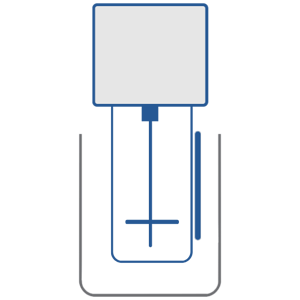
Rotational (spindle)
Brookfield
|
~200 mL with open beaker
Requires a large volume of each sample. Requirements vary significantly by model.
|
~10–10,000,000 cP; spindle- and model-dependent
|
Cannot specify specific shear rates, unless using a special adapter like coaxial cylinder.
|
~1–5 min per test or reading.
|
Basic spindle viscometers are easily cleaned. Add-ons for higher accuracy or lower sample sizes can be difficult to clean and prone to clogging.
|
Spindle and speed selection varies by user; open beaker has no built-in temp control.
|
Optional jacketed vessel or external bath; often used without temp control in QC. Lack of temperature control reduces accuracy.
|
|
Rotational (Cone and plate)
Anton-Paar
|
<1 mL (typically 0.5–0.7 mL)
Smaller sample requirements than other traditional methods. Although, rotational systems cannot test smaller than 100 µL.
|
~1-10,000,000 cP; depending on the specific model's geometry.
|
Well controlled shear rate. Uniform shear rate across full sample. Limited to low shear rates (typically < 5,000 1/s). Cannot run shear rate sweeps.
|
~2–10 min per sample test.
|
Time consuming. The narrow cone–plate gap must be carefully wiped and dried after each sample.
|
Trained user is needed to properly load sample in the plate. Underfilling artificially lowers viscosity, while overfilling without trimming the excess artificially increases the viscosity.
An untrained operator is likely to load bubbles that interfere with viscosity measurements.
|
Built-in Peltier element available for some models Typically 0–100 °C at ±0.1 °C.
|
|
Falling ball
Höppler principle
|
~10–40 mL to fill tube
Sample size requirements depend on the model. Cannot test without filling the full tube.
|
~0.5–100,000 mPa·s ball/tube-dependent
|
Limited to Newtonian fluids. Most accurate with transparent samples.
|
~5–15 min Automated inductive sensors speed up the process.
|
Cleaning a falling ball viscometer usually takes a few minutes per test. However, highly viscous substances require robust draining, soaking, and drying before additional testing can begin.
|
Manual timing in basic models. Automated sensors eliminate this user-to-user variation.
|
Jacketed tube with external thermostat work with standard models. Peltier is available for some automated models.
Fluid density must be known to accurately test at temp.
|
|
Vibrational (oscillating)
|
~10 mL and up; probe dips into any vessel. Testing requires a large volume to measure accurately. Typically only available as inline viscometers. Not a good option for individual sample tests.
|
~0.1–10,000 cP
|
Reduced accuracy for non-Newtonian fluids. Not available as stand-alone viscometer.
|
<1 min when integrated into a production or testing line.
|
Minimal cleaning required when properly integrated inline.
|
Inline models are highly consistent with little to no variation due to automation users.
|
No temperature control options.
|
|
Rotational
(Stabinger)
|
~1–3 mL
Cannot test less than 1 mL.
|
~0.2–30,000 cSt
|
Optimized for Newtonian fluids. Unreliable and limited testing for non-Newtonian fluids.
|
~2–5 min with automated filling. Filling rotational viscometers like the stabinger can be time consuming and tedious.
|
2 – 5 min per sample. Some models have partially autoamted cleaning.
|
A source of user error occurs during sample introduction. If an operator introduces air bubbles into the measuring cell or selects an incompatible cleaning solvent that leaves a microscopic film on the titanium rotor.
|
Integrated Peltier; wide range (e.g. −60 to 135 °C)
|
|
Microfluidic chip
Pressure-drop / flow-rate methods
|
~10–400 µL; some designs as low as ~10-15 µL. Microfluidic viscometers can measure very small sample volumes with high accuracy.
|
~1–650,000 cP typical; shear rates 3–1,400,000 s⁻¹ achievable
|
Yes. Highly accurate wih non-Newtonian fluids. Can test a variety of shear rates with one run. Provides first principle measurements.
|
Seconds to a few minutes per measurement. High-throughput automated platforms can run 96-well plates.
|
Chip channels require solvent flushing. Disposable options are available for some models eliminating cleaning.
|
Automated flow control and pressure sensing; minimal manual steps; results highly reproducible between users when chip is properly loaded.
|
Active temperature control (Peltier chip or external heater block) available on integrated platforms; range typically 4–70 °C. Some models require careful pre-conditioning of fluid and chip.
|
|
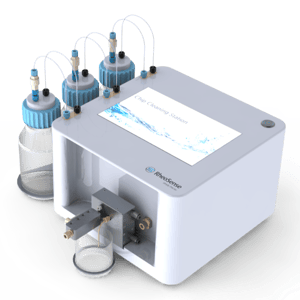
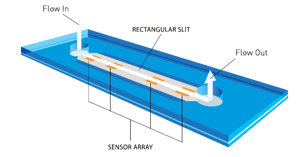
Rectangular slit
VROC® / USP <914> Method I
|
15 µL
Rectangular slit viscometers, like RheoSense VROC, can test very small volumes with very high accuracy and repeatability. Some models allow remaining sample to be recovered after testing.
|
~0.2–650,000 cP (chip-dependent); shear rates up to 5,000,000 s⁻¹ on high-shear models.
|
Yes. Defined, controllable shear rate and direct measurement of shear stress from pressure drop. Provides first principle viscosity measurements.
|
Seconds per data point.
High-throughput fully automated model can run 96 samples in 24 hours.
|
Miscible samples can be tested continually without cleaning in between (with most models).
Chips can be cleaned automatically.
|
Automated syringe pump controls flow rate precisely; minimal user variability ; accuracy ±2%, repeatability ±0.5% of reading. Automated and semi-automated models can run multi-temperature, multi-shear-rate sweeps unattended.
|
Integrated Peltier . 4–70 °C range typical with extended range available on some models.
|




.webp?width=300&name=m-VROC%20II%20(nbg).webp)