
What Automatic Microfluidic Viscometer is Best for You?
Need help deciding? We've got you!




Specifications are based on general ranges and may vary by specific model.
Small Samples
A key feature of all microfluidic viscometers is the ability to measure small samples. These samples, as small as 15 μL, are often incredibly precious to those developing them.
In order to better preserve precious resources, enable more testing with the same sample, and reduce the cost of sample disposal, VROC initium 1++ allows for retrieval and recovery of up to 90% of the original sample volume.
Other microfluidic viscometers require costly sample disposal of just one test along with the testing channel.
Learn More

First Principle Measurements
1st principle measurements are based on the first principle of viscosity: Viscosity equals shear stress divided by shear rate. In order to measure true (or absolute) viscosity, it is imperative that all instruments used measure using first principle.
In order to measure using first principle, shear rate must be closely and accurately controlled. Without this precise control, the equation will not provide accurate values.
Learn More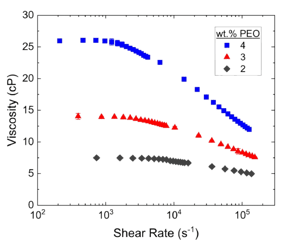
Intrinsic Viscosity
Intrinsic viscosity often an industry-standard parameter as it provides important information about the molecular weight of polymers and biopolymers. Molecular weight can dictate efficacy and other physical properties when the polymer is used in a formulation.
Measuring intrinsic viscosity without an automated solution can be tedious and time consuming. An accurate measurement of intrinsic viscosity requires multiple viscosity measurements at different concentrations that are then used to calculate intrinsic viscosity. This type of measurement requires high accuracy, clear results, and precise repeatability. With an automated solution such as the VROC initium 1++, multiple solution concentrations can be prepared and loaded into a liquid handler to automatically fill the 96 well plate connected to the instrument. From there, the process of measuring and calculating intrinsic viscosity is automated.
Other microfluidic viscometers fail to produce accurate intrinsic viscosity data due to poor repeatability and variability between disposable cartridge channels.
Learn More
When to Use
Microfluidic viscometers are a good choice if you are looking for measurements of small samples. They excel at measuring protein and polymer solutions such as those created in the pharmaceutical industry.
The VROC initium 1++ excels in a wide variety of industries due to its fully closed system and compatibility with volatile chemicals. The multi-use VROC chip removes any concerns about samples erroding or reacting to polymer-based disposable cartridges.